Showing posts with label Internet. Show all posts

Thursday, March 13, 2014

Happy Birthday, Internet!


The Web at 25 in the U.S. -- a report by the Pew Research Center

The overall verdict: The internet has been a plus for society and an especially good thing for individual users.

Some highlights of the report:
  • 53% of internet users say the internet would be, at minimum, very hard to give up, compared with 38% in 2006
  • 36% of internet users say email would be very hard to give up
  • 56% of internet users say they have seen an online group come together to help a person or a community solve a problem
  • 67% of internet users say their online communication with family and friends has generally strengthened those relationships, while 18% say it generally weakens those relationships
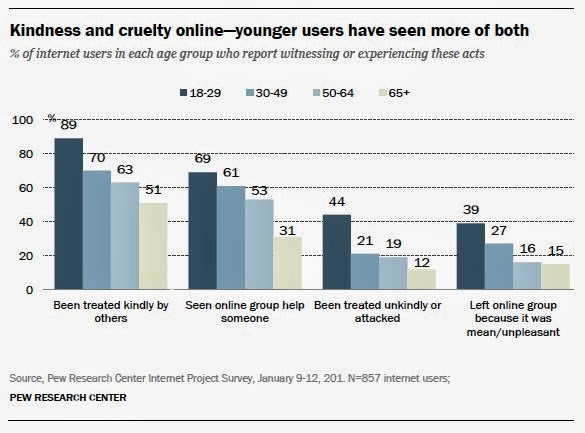

“Overall, when you add up all the advantages and disadvantages of the internet, would you say the internet has mostly been a good thing or a bad thing for you?” In response to this question, 90% of internet users say that overall the internet had been a good thing for them and 6% said it was a bad thing.

Wednesday, May 02, 2012

Is it a Reliable Website?

Here is a checklist of five things to evaluate about a website when determining if it is a reliable, credible, and accurate source of information.
1. Authority
    • Is the author a qualified expert in the field?
    • What is her/his occupation, position, education, experience?
    • What are her/his credentials?
    • Who endorsed or published the information?
2. Objectivity
    • What is the purpose of publication? Does the material inform? Explain? Persuade?
    • Are assumptions, personal bias and opinions clearly stated?
    • Is information presented in a clear and reasonable fashion?
    • Are conclusions supported by facts?
    • Is the site supported by advertising or run by a business?
    • Is the author affiliated with particular organizations, institutions, or associations?
3. Accuracy
    • What were the author's sources?
    • Was the work peer reviewed and/or edited?
    • Is the work free of grammatical and typographical errors?
    • Do facts and conclusions check out with other reputable sources?
4. Currency
    • When was the work written and published?
    • Are the author's sources up-to-date?
    • Has the information been updated or revised?
    • Is there provision for corrective feedback to the author?
5. Scope
    • Is it clear what topics are covered?
    • Are they covered in sufficient depth?
    • What is their relevance to your research? 
Evaluating Information on the Internet
Have a question? Ask a librarian!

Monday, February 20, 2012

Internet Resource - The Vault

Did you ever want to read the FBI files on ( Albert Einstein, Al Capone, John Lennon, Martin Luther King, Eleanor Roosevelt, Marilyn Monroe, Cesar Chavez, POW/MIAs, PETA, SNCC, ESP,Roswell, and much more? Now you can go to The Vault, the Federal Bureau of Investigation's electronic reading room, containing more than 3,000 documents that have been scanned from paper into digital copies.

This public access site was developed in response to the Freedom of Information Act. It does include a search mechanism and category browsing You can search the Vault by keyword and topic from Anti-War to Hot topics to Violent Crime. The site does provide some interesting insights into FBI case files but many of the PDF files of declassified records have been heavily scrubbed by blacking out names or phrases that might refer to classified information.

This website offer a unique opportunity to the public to view records that were previously closed


Tuesday, September 28, 2010

This Week in CQ Researcher

Impact of the Internet on Thinking
by Alan Greenblatt, September 24, 2010

Is the Web changing the way we think?

Due to the growing dominance of the Internet as the primary medium for commerce, entertainment and social communications, Americans are using more electronic media than ever. Some worry that the Internet, with its visual stimulation and constant distractions, is altering the way we think–and not for the better. Some studies indicate that it may alter physical mechanics of the brain that lead to long-term memory formation. And China and South Korea have declared “Internet addiction” a primary public health concern. But every new medium that comes on the scene has elicited similar fears about ill effects on popular taste and capacity for reflection and deep thinking. Still, there’s no question that the Internet is having profound effects on our lives–perhaps as great as any technological change since the advent of the printing press.

  • Does the Internet make us smarter?
  • Does the Web shorten attention spans?
  • Are people addicted to the Internet?


To read this article and others visit our Articles and Databases webpage and click on CQ Researcher. Select the Off Campus Access link for information on how to access this resource from off campus locations.

Monday, September 20, 2010

This Week in CQ Researcher

Impact of the Internet On Behavior
By Alan Greenblatt


In addition to its mammoth impact on commerce and media, the Internet also has had a profound effect on thinking and social behavior. Has the Internet made people more impatient? Shortened attention spans? It certainly has blurred the line between work time and leisure and family time. Many academic researchers and books are now arguing that the Internet is making us distracted and anxious. But plenty of countering voices say the amount of knowledge and communication facilitated by the Internet makes for a good tradeoff.

Author Nicholas Carr is in the middle of the debates. His new book, The Shallows, explores whether the Internet affects the way we think and process information. He thinks the effect has been negative, but others say the Internet is helping to create a collective intelligence that is adapting rapidly to the massive amounts of information that now come at plugged-in people every day.

To read this article and others visit our Articles and Databases webpage and click on CQ Researcher. Select the Off Campus Access link for information on how to access this resource from off campus locations.

Friday, December 04, 2009

Internet Resource: Biology Encyclopedia of Life Project

The Encyclopedia of Life Project is an ambitious effort to build an online reference source and database for the world’s 1.8 million named and known species, and to facilitate the discovery of those yet unknown.

Concieved by Edward O. Wilson, the project is backed by a robust amalgam of organizations, including The MacArthur Foundation, The Field Museum, Harvard University, The Marine Biological Laboratory, The Smithsonian, and The Biodiversity Heritage Library.


Watch the videos below. The first is a an entertaining montage explaining and demonstrating the concept, the second is a link to Edward O. Wilson’s TED Prize acceptance speech where he shares his wish for this project.


Edward O. Wilson acceptance speech.

Wednesday, November 11, 2009

Internet Resource: Newsy a video news site

Newsy is a multiperspective online video news site that monitors, synthesizes and presents the world’s news coverage.It take stories in the news and then bring together multiple video (and sometimes text-based) news reports from a number of sources and place them all on a single location. It’s not only a great way to see how a news story is reported but viewing the same story from different news organizations can potentially turn up facts from one source that the other source does not report on.


Newsy produces it's OWN original video content summarizing the material from each source into a single report. For those who don’t want to view each source video one at a time, here’s a way to learn what each one is reporting in just a minute or two.


You can keyword search Newsy or browse by one of seven categories:

+ World
+ Economy
+ U.S.
+ Politics
+ Tech/Sci
+ Environment
+ Culture


Also a Newsy iPhone app launched a couple of weeks ago.

Thursday, October 29, 2009

Internet Resource: Voxalead News Video Search


Voxalead News, finds keywords in transcriptions of video from mainly major US and French broadcast news resources. Run your search and the video clips appear on the screen, choose the one that you're interested in and the video starts a few moments before your word(s) appear to put it into some sort of context.

Thursday, July 09, 2009

Internet Resource - Academic Earth

This free online website provides more than 1,500 online videos of courses and individual guest lectures from six top-rated universities. At Academic Earth you can browse among the 17 discipline areas from Astronomy to Religion. The video courses are from Yale, MIT, Harvard, Stanford, UC Berkeley, and Princeton” and the lectures can be “browsed by subject, university, or instructor

Users can also download the video lectures to a PC or an iPod. You can also share the video content to a Facebook page and send them by email.

Academic Earth video lectures are a great way for you to learn more about a topic of interest for free!

Tuesday, February 17, 2009

Energy Saving Online Websites


Here is a list of useful energy saving and carbon footprint sites from the Reference Warehouse Series.


Wednesday, September 03, 2008

Google Launches New Web Browser

Google has released it new beta web browser call Chrome. This new browser is only available for Windows users with Mac and Linus versions coming soon.

One of the features of Chrome is a new approach to page rendering that isolates web applications inside each of the browser’s tabs — a crashing web app might cause a single tab to crash, but that won’t affect anything outside that tab. The rest of the browser remains stable.

For additional information about the Chrome browser visit these websites
http://www.google.com/chrome/intl/en/features.html

http://www.informationweek.com/news/internet/google/showArticle.jhtml?articleID=210300297

Monday, August 04, 2008

This Week in CQ Researcher

Internet Accuracy
by Marcia Clemmitt,
August, 1, 2008

Is information on the Web reliable?

The Internet has been a huge boon for information-seekers. In addition to sites maintained by newspapers and other traditional news sources, there are untraditional sources ranging from videos, personal Web pages and blogs to postings by interest groups of all kinds – from government agencies to hate groups.

Experts caution that determining the credibility of online data can be tricky, and that critical-reading skills are not being taught in most schools. Anyone can post an article, book or opinion online with no second pair of eyes checking it for accuracy, as in traditional publishing and journalism. Now many readers are turning to user-created sources like Wikipedia, or powerful search engines like Google, which tally how many people previously have accessed online documents and sources – a process that is open to manipulation.

To read this article and others visit our Articles and Databases webpage and click on CQ Researcher. Select the Remote Access link for information on how to access this resource from off campus locations.

Wednesday, April 16, 2008

Internet Resource - History Matters

History Matters: the U.S. Survey Course on the Web http://historymatters.gmu.edu/


This history site serves as a gateway to United States history web resources and offers first-person primary documents, guides to analyzing historical evidence and teaching materials.

The feature called "Many Pasts" contains more than 1,000 primary documents that portray the lives of ordinary people throughout U.S. history. The section WWW.History provides annotated guides with links to other sites that can be useful in research and teaching U.S. History.

The entire website is also searchable. This online resource was created by the American Social History Project at City University of New York and the Center for History and New Media at George Mason University.

For additional history websites view our History Internet Subject Guide webpage