Attend a one-hour introductory session and learn about SWC's Blackboard Online Learning System. These sessions are free -- no sign-up necessary. Sessions are offered at Main Campus, National City, and Otay Mesa. Please be on time.
Main Campus: Room L244 (Library/LRC)
Thursday - October 16 - 5:30 PM
Friday - October 17 - 12:30 PM
Tuesday - October 21 - 11:00 AM
Higher Ed Center, National City: Room 7202B
Wednesday - October 15 - 4:30 PM
Higher Ed Center, Otay Mesa: Room 4423
Thursday - October 16 - 1:30 PM
For more information about online classes, visit the SWC Online Learning website.
Monday, October 13, 2008
Friday, October 10, 2008
Got a Question? Need an Answer?

Try our Online Reference Chat Service
Real People - Real Help - Real Fast
24 hours a day, 7 days a week
http://www.swccd.edu/~library/ask.htm
Real People - Real Help - Real Fast
24 hours a day, 7 days a week
http://www.swccd.edu/~library/ask.htm
Wednesday, October 08, 2008
Facts.com Issues and Controversies in American History
 With Issues and Controversies in American History, history comes to life and help builds a deeper understanding of how historical events have shaped our nation by exploring the key players and the battles they fought.
Issues and Controversies in American History is updated biweekly with links to overviews and background articles, touching on crucial topics from Colonial America to the present. This online resource provides arguments for and against, giving a framework for understanding and analysis of each issue—as it was seen in its time and as it relates to our own.
This resource also includes presidential election coverage, timelines, photographs, statistical charts, explanatory diagrams, maps, and cartoons.
To use Issues and Controversies in American History on-campus visit our Articles and Databases webpage. Select the Remote Access link for information on how to access this resource from off campus locations.
Tuesday, October 07, 2008
Top Shelf
by Sidney Laramie and Ann Willard, SWC Librarians
Top Shelf is a weekly column where librarians share some of their favorite resources with you.
Book Selection
Historical Statistics of the United States : Earliest Times to the Present
Cambridge University Press, c2006 (5 vols.)
Call #: Ref HA202 H57 2006
I chose to highlight this source because I had never seen it before and because I envision more and more students being assigned to compare aspects of our current economy or government to those of an earlier period (e.g. The Great Depression). Such students should find the chapter on “Business Fluctuations and Cycles” in Vol. IV. to be helpful. There I learned that 3,460 banks were “suspended” in March 1933.
This work is actually a “… revised, updated, and [greatly] expanded Millennial Edition…” of the standard, two volume set last published in 1975. This new edition includes additional topics such as American Indians, slavery, the Confederate States, and poverty. It also gives broader coverage to existing topics and extends the old data by as much as an additional 30 years.
The five volumes which now comprise the set are subtitled as follows: I. “Population”; II. “Work and Welfare”; III. “Economic Structure and Performance”; IV. “Economic Sectors”; and V. “Governance and International Relations”. Each volume averages 850 pages, and contains from seven to nine chapters, all of which have at least one introductory essay. The introductions discuss the statistics in that chapter, the trends observed in them, and give references for further research.
The information available in this set is much broader than one would expect. For example, in glancing through the introduction to the “Population” volume I noticed the foundation of my alma mater listed in a chronology entitled “Important Events in the History of Race, Ethnicity, and Gender: 1619-2003. In the American Indians chapter of the same volume I discovered a list of the amount and price of timber cut on Indian land between 1910 and 1998. Vol. IV. even contains the attendance at NCAA basketball and football games.
-Sidney.
Website Selection
Petfinder
www.Petfinder.com is a wonderful website which links almost 12,000 animal shelters, humane shelters and animal foster care groups from around the country. If you are thinking of adopting a pet or are trying to find a pet you have lost, the pet finder search engine allows you to specify the type of animal, sex of the animal, age, color, and even the breed, located within a few miles of your zip code. Are you missing a pig? No problem, pet pigs are included on the list of animals. The search remembers the last few animals you have viewed, so after looking at perhaps a half dozen potential pot-bellied pigs to adopt, their photos will be displayed at the bottom of your screen. Each entry includes a little description of the personality of each animal and lets you know which group to contact for more information. The pet entries are even coded so that you can quickly identify cats which are declawed, or cannot be in homes with children, etc.
Ok, so community college libraries may not get many people asking about how to find their lost pets. Petfinder.com also has much more information on the site. There are cat breed and dog breed directories; pet training videos; volunteer and donation opportunities; articles on all kinds of pet-related subjects and FAQ’s, including how to ‘go green’ with your pet and how to deal with pet separation anxiety (for the pet’s anxiety, not yours); a PetFinder.com newsletter and blog; and a shopping site. And go to the Fun section of Petfinder and find free e-cards to send your friends. Petfinder.com is well worth a visit!
-Ann.
Top Shelf is a weekly column where librarians share some of their favorite resources with you.
Book Selection
Historical Statistics of the United States : Earliest Times to the Present
Cambridge University Press, c2006 (5 vols.)
Call #: Ref HA202 H57 2006
I chose to highlight this source because I had never seen it before and because I envision more and more students being assigned to compare aspects of our current economy or government to those of an earlier period (e.g. The Great Depression). Such students should find the chapter on “Business Fluctuations and Cycles” in Vol. IV. to be helpful. There I learned that 3,460 banks were “suspended” in March 1933.
This work is actually a “… revised, updated, and [greatly] expanded Millennial Edition…” of the standard, two volume set last published in 1975. This new edition includes additional topics such as American Indians, slavery, the Confederate States, and poverty. It also gives broader coverage to existing topics and extends the old data by as much as an additional 30 years.
The five volumes which now comprise the set are subtitled as follows: I. “Population”; II. “Work and Welfare”; III. “Economic Structure and Performance”; IV. “Economic Sectors”; and V. “Governance and International Relations”. Each volume averages 850 pages, and contains from seven to nine chapters, all of which have at least one introductory essay. The introductions discuss the statistics in that chapter, the trends observed in them, and give references for further research.
The information available in this set is much broader than one would expect. For example, in glancing through the introduction to the “Population” volume I noticed the foundation of my alma mater listed in a chronology entitled “Important Events in the History of Race, Ethnicity, and Gender: 1619-2003. In the American Indians chapter of the same volume I discovered a list of the amount and price of timber cut on Indian land between 1910 and 1998. Vol. IV. even contains the attendance at NCAA basketball and football games.
-Sidney.
Website Selection
Petfinder
www.Petfinder.com is a wonderful website which links almost 12,000 animal shelters, humane shelters and animal foster care groups from around the country. If you are thinking of adopting a pet or are trying to find a pet you have lost, the pet finder search engine allows you to specify the type of animal, sex of the animal, age, color, and even the breed, located within a few miles of your zip code. Are you missing a pig? No problem, pet pigs are included on the list of animals. The search remembers the last few animals you have viewed, so after looking at perhaps a half dozen potential pot-bellied pigs to adopt, their photos will be displayed at the bottom of your screen. Each entry includes a little description of the personality of each animal and lets you know which group to contact for more information. The pet entries are even coded so that you can quickly identify cats which are declawed, or cannot be in homes with children, etc.
Ok, so community college libraries may not get many people asking about how to find their lost pets. Petfinder.com also has much more information on the site. There are cat breed and dog breed directories; pet training videos; volunteer and donation opportunities; articles on all kinds of pet-related subjects and FAQ’s, including how to ‘go green’ with your pet and how to deal with pet separation anxiety (for the pet’s anxiety, not yours); a PetFinder.com newsletter and blog; and a shopping site. And go to the Fun section of Petfinder and find free e-cards to send your friends. Petfinder.com is well worth a visit!
-Ann.
Monday, October 06, 2008
ARTstor Collection Release: Mexican Retablos
 ARTstor, in collaboration with Douglas Massey, has recently added 170 images of Mexican retablos to the Digital Library. Retablos are small, colorful oil paintings made on tin and offered as votives of thanks for miracles granted and favors bestowed.
Douglas Massey photographed retablos dating from 1912 to 1996, which appeared in Miracles on the Border: Retablos of Mexican Migrants to the United States (University of Arizona Press, 1995), a book co-authored with Jorge Durand. These images represent modern expressions of the traditional Mexican folk art genre. The bright palette and vibrant style that characterizes this art form later influenced the work of Mexican artists such as Frida Kahlo and Diego Rivera.
To view the Mexican Retablos Collection (Douglas Massey): go to the ARTstor Digital Library, browse by collection, and click "Mexican Retablos Collection (Douglas Massey);" or enter the Keyword Search: massey retablos.
To view ARTstor from off campus locations you need to create an ARTstor account at http://www.artstor.org/ from any on campus computer.
Wednesday, October 01, 2008
October eBook of the Month
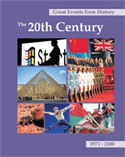
The featured NetLibrary eBook of the month during October is "Great Events from History: The 20th Century, 1971-2000", edited by Robert F. Gorman.
This electronic version provides extended coverage of major events between 1971 and 2000. The late twentieth century was a time of significant advances in science and technology. Space probes explored comets and the outer planets. Personal computers were born and quickly grew to change the way people all over the world work, play, and communicate.
The events covered include geopolitical events of the era - from end of U.S. involvement in the Vietnam War in 1973 to the breakup of the Soviet Union in 1991. Essays also address important social and cultural developments in daily life: major literary movements, significant developments in the arts and motion pictures, trends in world population and immigration, and landmark social legislation.
If you have already established a NetLibrary account through Southwestern College Library, visit http://www.netlibrary.com/ and log in to read "Great Events from History: The 20th Century, 1971-2000" or any of our other 19,000 electronic book titles.
If you do not have a NetLibrary account, you can create your own account from any computer on the Southwestern College campuses. Visit our NetLibrary information page .
This Week in CQ Researcher

Gay Marriage Showdowns, by Kenneth Jost,
September 26, 2008
Will voters bar marriage for same-sex couples?
The California Supreme Court gave gay rights advocates a major victory in May, ruling the state’s constitution guarantees same-sex couples the same marriage rights as opposite-sex pairs.
Opponents, however, have placed on the state’s Nov. 4 ballot a constitutional amendment that would deny marriage rights to same-sex couples by defining marriage as the union of one man and one woman. Similar proposals are on the ballot in Arizona and Florida. The ballot-box showdowns come as nationwide polls indicate support for some legal protection for same-sex couples, but not necessarily marriage equality.
- Should same-sex couples be allowed to marry?
- Should state constitutions prohibit marriage for same-sex couples?
- Should states recognize same-sex marriages from other states?
To read this article and others visit our Articles and Databases webpage and click on CQ Researcher. Select the Remote Access link for information on how to access this resource from off campus locations.
Subscribe to:
Comments (Atom)

 What's New @ SWC Library