Showing posts with label Fake News. Show all posts

Wednesday, May 03, 2017

10 Ways to Spot Fake News

Source: Kirschenbaum, Michele. EasyBib. 1 Feb 2017. 

http://www.easybib.com/guides/evaluating-fake-news-resources/


Is it true? Is it biased? How can you tell?

Here are a couple of handy guides to figuring out the quality of information.

Ten Ways to Spot Fake News
Michele Kirschenbaum's "Ten ways to spot a fake news article" on EasyBib provides some easy tips for spotting fake news.

SWC Library -- Evaluation Criteria
You can also apply the five evaluation criteria from the SWC Library website to determine the credibility, the bias, and the accuracy of what you are reading.

Have a question? Ask a librarian!

Friday, April 14, 2017

Fake News Workshop

What is fake news? How can you avoid it? Join us for a free half-hour workshop on Thursday at noon!

30 Minute Thursdays -- Fake News

Noon - Room L-244


Monday, March 13, 2017

30-Minute Thursday -- Join us!

Fake News: Be a Smart Skeptic

It's more essential than ever that we know how to critically evaluate information. These days, there are so many factors involved in both the production of information and the way in which information is disseminated.

On top of the variety in quality of information out there, we bring our own points of view to the conversation. We tend to seek out information that we agree with (confirmation bias). We use social media for brief updates, but we don't always read everything thoroughly. We might tend to rely on just one or two sources for news.

Join us on Thursday to learn more about how to avoid the Fake News trap! Learn how to be a smart skeptic.
 
Ask your instructor if extra credit is available for attending.

Where: L-244
When: Thursday, March 16, at noon
What: Fake News: Be a Smart Skeptic


Tuesday, February 14, 2017

Fake News?

We hear a lot about "Fake News" lately... what exactly is Fake News?

Definition of Fake News
Fake News is completely false information. It is created by an author who knows it is completely false information, but has purposefully attempted to make it look real to try to spread misinformation.

Why?

The motives for Fake News are either economic (the author makes money from advertising every time someone clicks); or political/social (the author wants to direct public opinion).

Fake News is NOT:
  • Bias -- Information may contain opinion, but that doesn't automatically make it Fake News.
  • News You Disagree With -- You may not like a particular news article, but that doesn't mean it's Fake News.

Examples of Fake News
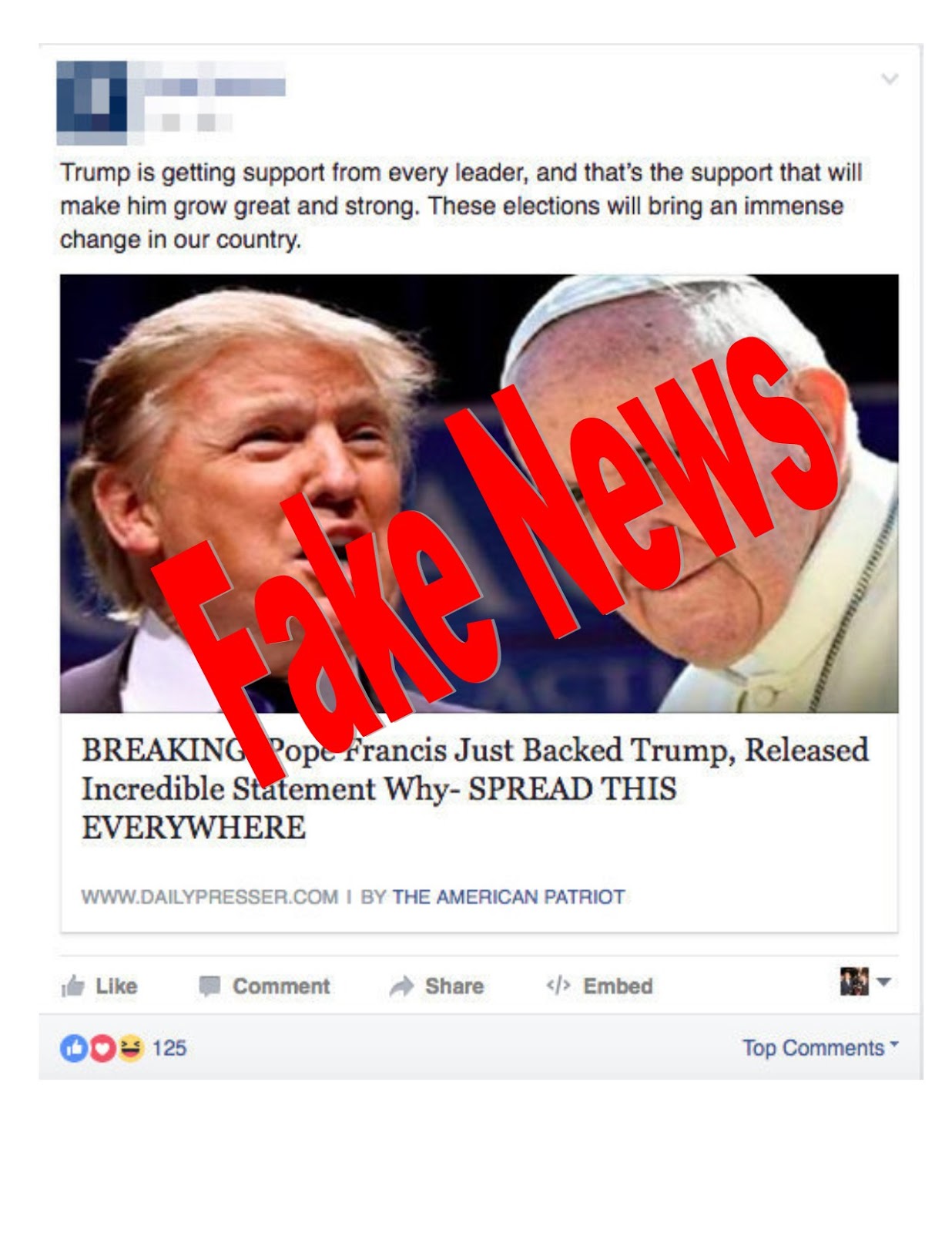
Here are some recent examples of Fake News that are completely false and were created either to make money through advertising or because of a political/social agenda.

Bogus Ballot Stuffing Story


Pope Warns About Fake News -- From Experience


Want to know more about how to identify Fake News? Here's a handy quick guide, created by Michele Kirschenbaum, a Librarian at EasyBib.


We are also offering a 30-Minute Workshop on the topic of Fake News -- join us in Room L-244 at noon on March 16 or April 20.

For more assistance on this topic -- or any other aspect of your research -- Ask a Librarian!